
Drills & Exercises
An organized library of training drills for different types of skills. Step-by-step guidance with pictures to help you. Progress chart to see how things are getting better.
Warm Up/Ball Work (25 min)
All players: Stretch (5 min) & Juggle (100 touches)
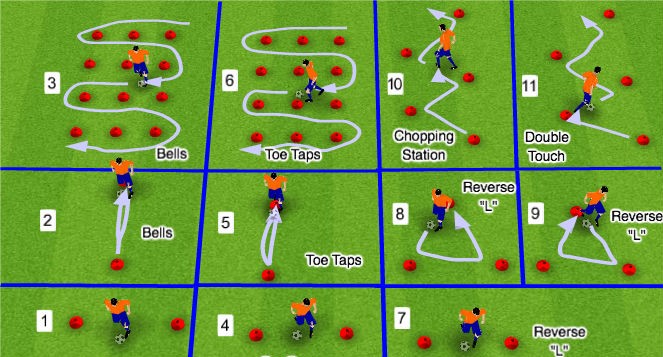
Stations (45 sec per station)
1- Standing Bells, 2- Forward/Reverse Bells, 3- Channel Bobble Bells, 4- Standing Toe Taps, 5- Forward/Reversde Toe Taps, 6- Channel Bobble Toe Taps, 7- Standing Reverse "L", 8- Triangle Station Reverse "L" Right Foot, 9- Triangle Station Reverse "L" Left Foot, 10- Cutting Station Chopping L/R Foot, 11- Cutting Station Double Touch (1 R Lace Dribble, 2 sole roll across body, 3 L Lace Chop Dribble)
Tactical Analysis
A breakdown of game strategies, such as formations and set pieces. Diagrams and examples that you can alter. Case studies of well-known matches.
Game Phases
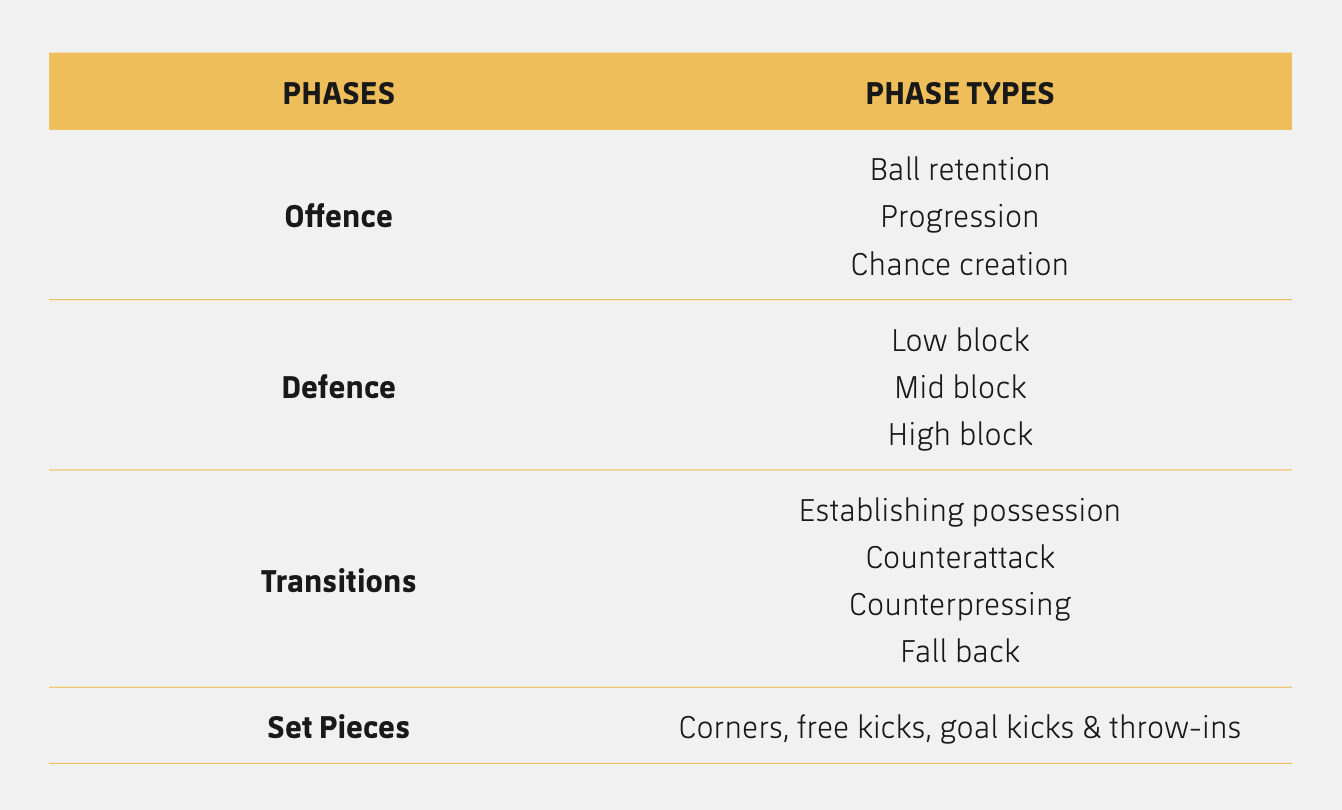
A team's formation will vary depending on the game phase. The concept of game phases comes from the idea that any time during a match can be classified depending on each team's current goals. There is no commonly agreed definition of game phases.
In this example, matches are divided into four phases: offence, defence, transitions, and set pieces, each with its own set of phase characteristics. The Offensive phases divide times of possession into three categories: ball holding (keeping possession of the ball), moving the ball towards the opponent's goal, and actively creating opportunities. Defensive phases effectively indicate how far up the pitch the club wants to defend. The Transition phases address a team's intentions in the seconds following an exchange of possession. Set pieces identify all dead ball scenarios (which might be further refined into 'first ball','second ball', and so on).
Automated detection of game phases is a difficult technical problem, and many current categories rely on human analysts' judgements rather than algorithms. Because game phases are essentially connected to where a team is on the pitch, one simple technique is to define game phases based on the team's distance from its own goal.
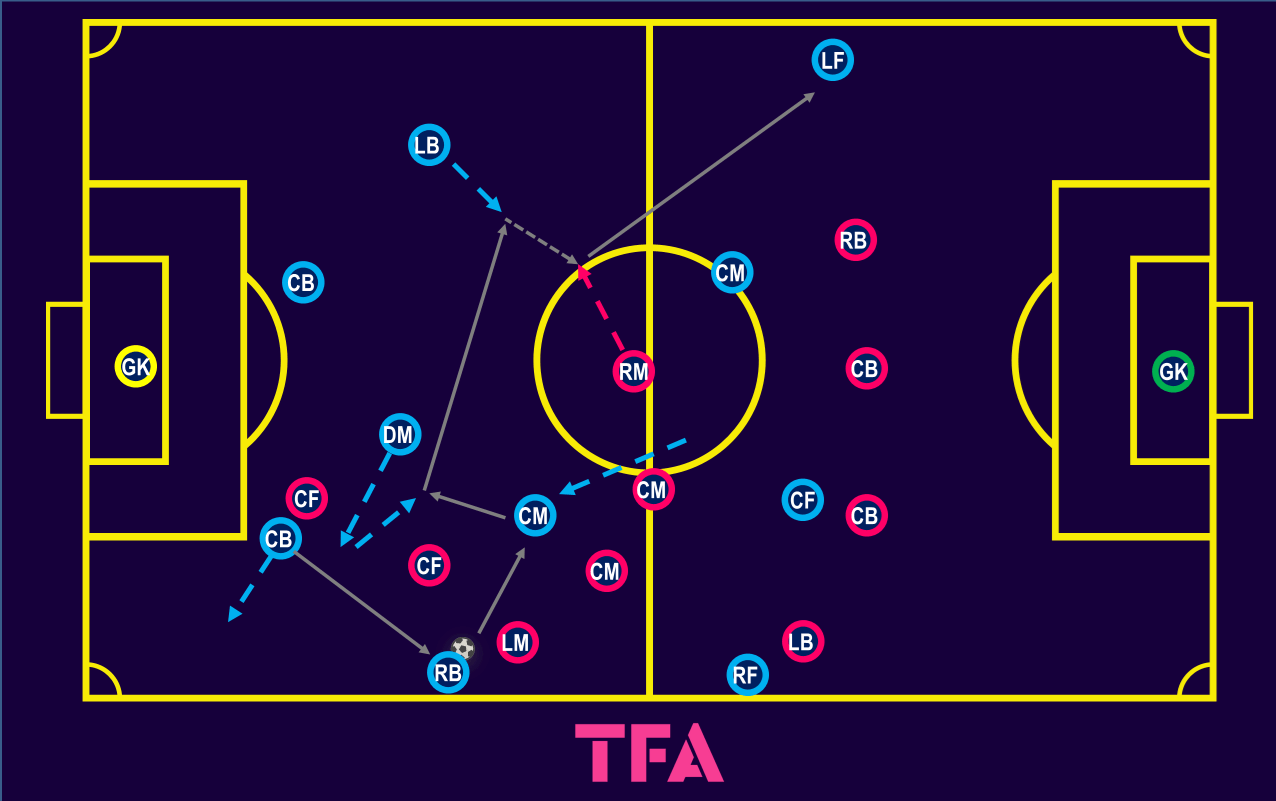
Switching against a mid-block
The tactical diagram shows one way to change the point of attack when facing a 4-4-2 mid-block. As you can see, the pink team is trying to suffocate the blue team that is attacking on one side of the field. The blue team's midfield has made holes to run into by being patient at first and staying away from the ball.
The ball being played into the right-back triggers the two ball-near midfielders to make their runs and create a triangle around the ball. The centre-back, who played the pass into the right-back, helps create space for the triangle by immediately dropping off after playing the pass. The right-back, receiving the ball facing inside the pitch, plays the next pass with the first or second touch. This gives the opposition little time to react and allows the midfielder to receive on the move, making the midfielder impossible to pick up.
By electing to play with the more advanced midfielder, the ball can be bounced backwards, allowing the defensive midfielder to swing the ball to the opposite full-back. When the left-back receives the ball, the first action should be to take a diagonal touch towards the opposition’s widest midfielder.
The opposition’s preference in this scenario would almost certainly be to drop diagonally whilst keeping their shape. Once set up securely and the opposition cannot play forward, they would then squeeze the in-possession team on the opposite side of the pitch. Taking a diagonal touch inside the pitch, the left-back pins the widest midfielder, making it difficult for the team to shift over entirely. This can lead to the defending team’s full-back being exposed one-on-one against the wide forward.
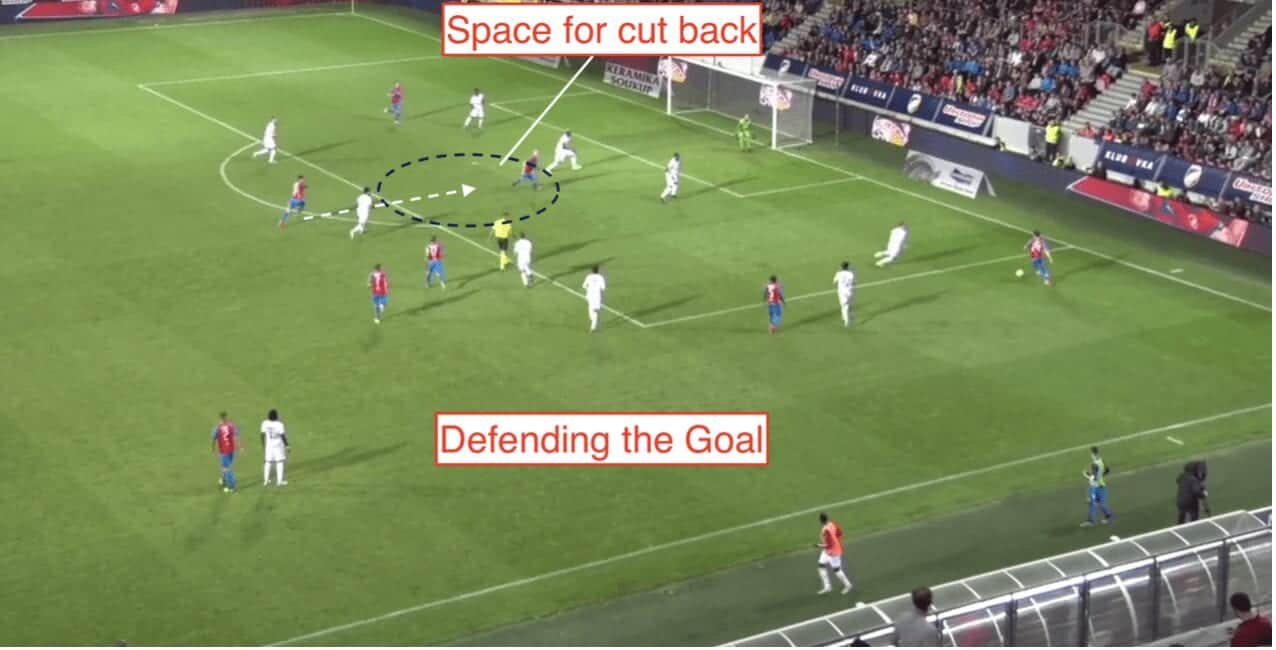
Defending The Goal
There are far less possibilities on how to defend the goal. The main variables here are often how many and which players remain on the pitch when a team defends its goal. This is heavily linked to the opponent's attacking transition phase. If we can identify who stays on the pitch and what type of player they are, we can begin to recommend tactics to counter their threats, allowing our team to maintain attacks and remain in the last 1/3 phase.
Another important piece of information to look for is how deep the defenders go. If a team drops players directly on top of their goalkeeper, we know everyone is on board. When teams defend very deep, there is often greater space around the penalty spot. In this case, we could recommend cutting back or pulling back crosses.
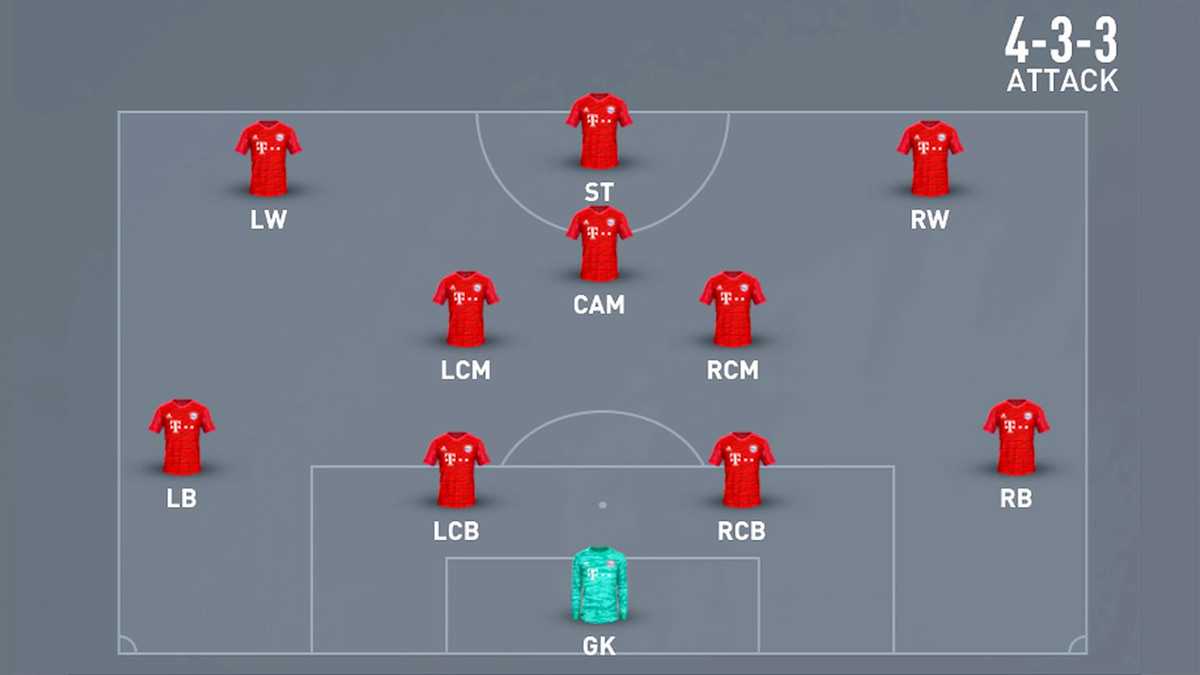
Attacking with a 4-3-3 Formation
The 4-3-3 formation is popular for teams seeking to dominate possession and create scoring opportunities. This formation includes four defenders, three midfielders, and three attackers.
Key Features:
- Wide Play: In a 4-3-3 formation, wingers play an important role in attacking. They frequently stay wide to stretch the opposing defense and make space for center midfielders and attackers.
- Midfield Control:With three center midfielders, the team can keep control of the midfield and set the pace of the game. The central midfielders assist both defensively and offensively.
- Forward Movement: The three strikers in a 4-3-3 formation provide offensive options. The center forward (striker) serves as the attack's focal point, with the wingers providing width and assistance by running behind the opposing defense.
Attacking Patterns:
Teams that use the 4-3-3 formation frequently use the following offensive patterns:
- Build-up from the back: The team begins attacks from the defense, with the goalkeeper and defenders maintaining possession from the back. The full-backs put forward to give width, while the midfielders try to generate passing triangles to move the ball.
- Wing Play: The team hopes to take advantage of space on the wings by utilizing the pitch's width. The wingers make overlapping runs or cut inside to create scoring possibilities, while the full-backs assist by overlapping or providing crosses into the area.
- Central Penetration: The team's goal is to get through the opposition's central defense with quick passing and movement. The central midfielders try to help the offense by playing through balls to the forwards or making late runs into the area.
Fitness & Conditioning
Customized Workout Plans
Below are customized workout plans tailored specifically for football players:
| Day | Workout Plan | Duration |
|---|---|---|
| Monday | Strength training (lower body) | 60 minutes |
| Tuesday | Cardiovascular conditioning (interval running) | 45 minutes |
| Wednesday | Rest day | N/A |
| Thursday | Agility drills and speed training | 45 minutes |
| Friday | Strength training (upper body) | 60 minutes |
| Saturday | Endurance training (long-distance running) | 90 minutes |
| Sunday | Rest day | N/A |
Nutrition Tips
Optimal nutrition is essential for peak performance on the field. Here are some nutrition tips for football players:
- Stay hydrated by drinking lots of water throughout the day, especially before, during, and after workouts and games.
- Consume a variety of carbohydrates, proteins, and fats to fuel your workouts and help in repairing damaged muscles.
- Consume a wide range of fruits and vegetables to ensure you get enough vitamins and minerals for good health and performance.
- Avoid sugary and prepared foods, and choose healthy foods that provide consistent energy and nutrients..
- Consider consulting with a nutritionist or dietitian to create a personalized dietary plan that addresses your individual requirements and goals.